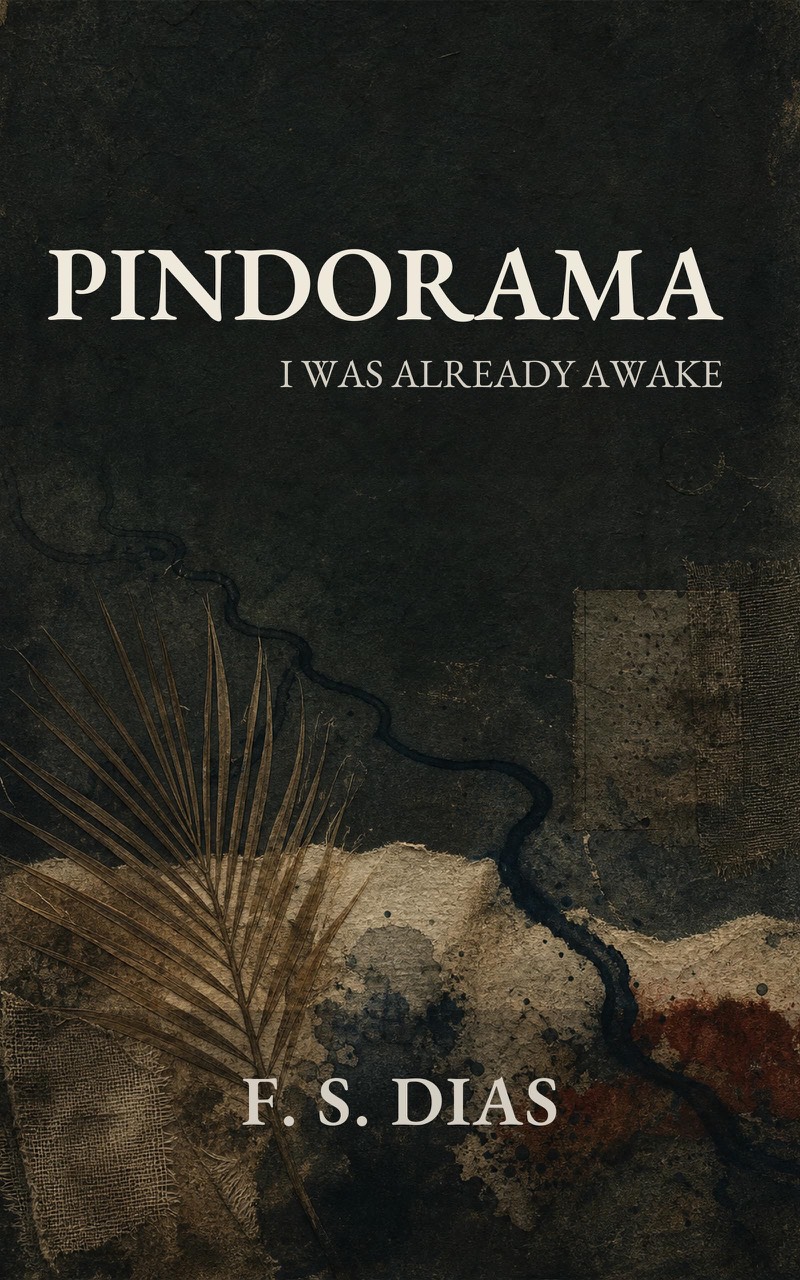
“I have no beginning.”
That was how I found the voice of Pindorama.
It was not the voice of a character looking at the landscape. It was not a historian assembling events after everything had already been given a name. Nor was it a presence above time, able to enter every mind and explain every human gesture.
The territory itself was speaking.
Before Brazil, before borders, before any map attempted to contain it within a final shape, the place was already there. It felt weight, heat, water, blood, roots, buildings, and movement. It carried marks. It did not understand everything, because a territory cannot enter human intimacy as an omniscient narrator might. But it remained when people left, when names changed, and when one age tried to erase the one before it.
That decision changed the entire novel. The story no longer needed merely to happen somewhere. The place became what could join centuries no human character could ever cross.
The land as witness, not setting
In much of fiction, territory provides context. It can create atmosphere, establish distance, offer resources, impose obstacles, or carry symbolic meaning. Even then, it usually remains in the background while characters lead the narrative.
In Pindorama, I wanted to reverse that relationship. The territory does not illustrate history: it witnesses it. Its memory is not arranged like a human archive. It is material. A forest brought down, a road cut open, a river altered, or a city built over earlier layers are not simply events it observes. They are changes to its own body.
This also changes the meaning of time. For a human life, a few decades can contain everything. For a territory, one generation is a brief passage. The narrating voice can follow arrivals, violence, endurance, and disappearance without pretending that continuity belongs to a family, a government, or an official account of history.
The territory remains. Remaining, however, does not mean remaining untouched.
Territory is not country
This distinction is central to Pindorama. The narrator exists before the country and cannot be reduced to it.
Brazil is a historical, political, and linguistic construction. The territory that speaks in the novel comes before that construction and exceeds every name imposed upon it. It does not represent the state. It does not speak for Indigenous peoples, colonisers, enslaved people, migrants, or their descendants. To appropriate those voices would create an authority the book does not wish to claim.
The territorial narrator perceives what reaches its material body and recognises the limits of what it can know. It witnesses human presence without replacing human experience. It may register a crossing, an occupation, or a wound, but it cannot possess the inner lives of everyone involved.
That limitation does not weaken the voice. It gives the voice its form.
A history measured through ordinary lives
Pindorama moves from a morning before recorded years to a bus journey in 2030. Across that span, events that usually occupy large chapters of history enter the novel at another scale.
Palmares, Porongos, the 1918 influenza epidemic, the building of Brasília, and the expulsions of the Estado Novo do not appear as a sequence of summaries. They reach people who must plant, flee, work, translate, care for one another, and live with decisions made far away. The territory knows what came afterwards, but every character continues to live without the assurance of knowing what any choice will produce.
That difference matters. To someone reading history backwards, an event can seem inevitable. To those who lived through it, uncertainty, chance, and the possibility of failure remained. The narrator can connect periods, objects, and consequences, but it does not steal the uncertainty of the present from its characters.
For that reason, the novel often prefers one full day to a century condensed. Within a single day, a person may still resist what the century appears to have decided for them.
What the land knows, and what it does not
The voice of Pindorama recognises the weight of a falling body, the point where a hoe enters the soil, footsteps arriving or fleeing, a forehead resting against a closed door. Yet reading a body does not mean knowing a person in full. A hand may tremble from fear, fever, or cold. When the narrator names what it perceives, it is interpreting. It may be wrong.
This contract prevents the territory from becoming a total explanation. It knows continuity and consequence, not every thought. It carries marks, not final answers. What a community keeps for itself remains its own. What no one said is not completed simply to make history more convenient.
Nor does the territory tell a miniature History of Brazil. Kings, laws, battles, and governments enter when they reach someone's life, sometimes as rumour, delay, absence, order, or paper. Large history is perceived through the weight it places upon a small gesture.
Is this new?
Literature has long experimented with nonhuman narrators. Animals, trees, objects, the dead, and other presences have been given voices across many traditions. I would not claim to have invented nonhuman narration, nor would I claim that no writer before me has ever allowed a land to speak.
What seems less common is this particular combination: a territory speaking in the first person across centuries, without becoming an omniscient deity, representing a people, or merging with the state. Rather than serving only as allegory, the voice follows perceptual limits shaped by matter, time, and the marks left upon it.
I am not interested in claiming a literary first as a marketing strategy. I am interested in saying clearly what the novel attempts and in inviting readers to recognise the unusual experience it offers.
When the ground is no longer background
Perhaps Pindorama belongs to a larger question: what does history become when it no longer belongs only to those who won, recorded it, or survived to tell it?
A territory is not neutral. It receives the consequences of every human project, even after those responsible have disappeared. It holds ruins beneath new buildings, former watercourses beneath streets, and imagined borders across material continuities. When it narrates, it does not correct history or provide a total account. It offers another scale through which to perceive it.
In Pindorama, the voice begins by saying it has no beginning. It is a sentence about territory, but also about our need to choose a starting point and call everything we manage to record after it an origin.
The novel begins there: at the moment when place stops being background and begins to speak.
Back to the website